Industrial Design in the Digital Age: Non-Stop Learning and Integration—Exclusive Interview with Yi Wei-Shen
Contributor: Yi Wei-Shen (President of Chinese Industrial Designers Association)
Editor: Wu Cheng-Yuan, Guo YuSyuan, Tsai Yi-Chieh
“Building a brand isn’t about catering to the market; it’s about creating the market.” Alan Yi Wei-shen, founder of Afterain Design and CEO of the Chinese Industrial Designers Association (CIDA), has extensive experience in brand building. Brand “CiCHi” renowned for Happiness Cup, “JSL Craft” known for its ceramic coffee filter with composite mineral sand, and “MAKE3BOX” that produces culturally rich packaging material, are all the fruits of collaboration between him and the designers at Afterain Design.
Become an Industrial Designer with Strong Learning and Integration Skills
Yi Wei-shen believes that “learning ability” combined with “integration ability” is crucial. From product design and business operations to marketing strategies, everything evolves rapidly with technological advancements. Knowing how to learn new tools, integrate available resources, and turn ideas into tangible results are essential skills for today’s designers.
“As an industrial designer, you can’t just be ‘good at ideas.’” In an age overflowing with software tools, whether designers are willing to explore and experiment makes all the difference. According to Yi Wei-shen, to find out whether a designer is truly qualified, let them “run” a project once; take “modeling” for example, it requires drawing one line, two lines, then three or four lines to form a surface, gradually building up a three-dimensional shape following specific steps. Whether someone can draw it properly is one measure of their learning ability. Beyond mastering the basics through active learning, designers must also cultivate their own reservoir of creative nourishment from all aspects of life.
As for nurturing creativity, Yi says you should simply see more. Back in college, he loved spending time in libraries. Though he was not particularly fond of studying, he enjoyed flipping through illustrated catalogs, studying shapes, or exploring materials. He often found a wealth of diverse design information in yearbooks and design annuals; even a quick glance could yield great inspiration. After the Taiwan Design Center (the predecessor of the Taiwan Design Research Institute) was established, he kept up this habit, regularly browsing magazines there. Yi says, “Learn broadly without limiting yourself to any one area. Only when you have absorbed all that knowledge and applied it in your design work does it truly become effective integration.” In his early days, Yi often practiced “prototype transformation.” For example, turning the idea of a switch panel into something completely different. This kind of exercise helps designers break out of rigid thinking. When applied to advertising, it can also create surprising effects, like how McDonald’s once used the beams from two street lamps to form its iconic “M.” Integrating everyday objects is often at the heart of creativity. “Read more books, learn about history, geography, and other knowledge. When you weave these into your product designs, that’s when you truly demonstrate effective integration.”
Digital Tools Are Just Your Pen, What You Draw Still Depends on You
In the creative process, one of the most painful aspects for industrial designers is the related calculations of the manufacturing process. For example, in plastic injection molding, you have to consider mold flow analysis, shrinkage and deformation rates, the direction and angle for releasing the mold, and so on. Yi believes that if, in the future, AI can perform these calculations based on related parameters and even make automatic adjustments, it could save a huge amount of time when serving clients by processing this data. He is confident that this will be a key trend in the future of industrial design and AI applications.
In terms of workflow, Yi believes that if AI can handle repetitive and time-consuming tasks, the time saved would be a huge benefit for him. For example, when preparing a proposal presentation, the preparation time is usually very short, yet designers still need to build 3D models, render them, and apply material settings, which are all time-consuming tasks. Now, he can take a finished sketch and run it through a tool like Vizcom for rendering, then do some final post-processing himself to quickly generate proposal visuals. “What used to take two days can now be 80% done in two minutes, then it goes straight into the proposal process. Even if you don’t win the bid in the end, it doesn’t hurt so much,” Yi says with a smile.
Back when he was a student working part-time at a design company, much of his time was spent “helping with drawing,” turning his boss’s sketches or spoken ideas into tangible visuals. Yi says that now, with AI, many people can essentially be their own boss, letting AI handle those tasks so designers can focus on elevating themselves into decision-makers. “Learning many tools, from industrial design to AI generation, is indeed important for designers, but in the end, it still comes back to the question: ‘What do you want to do with these tools?’ That’s how you build both your hard and soft skills together.”
“Just Do It First” — Finding Market Opportunities Through Trial and Error
- From Pure Creation to Developing Market Awareness
Yi Wei-Sheng says, “I hope to first highlight the value through designers’ personal brands, and ‘Produced by Afterain’ comes second.” In the past, it was very difficult for industrial designers to get noticed. Even setting aside the question of having the right channels or opportunities for exposure, a single design project often takes at least a year to complete, some even taking two or three years or more. Yi hopes to use his company’s resources to change the disadvantaged position of Taiwanese industrial designers.
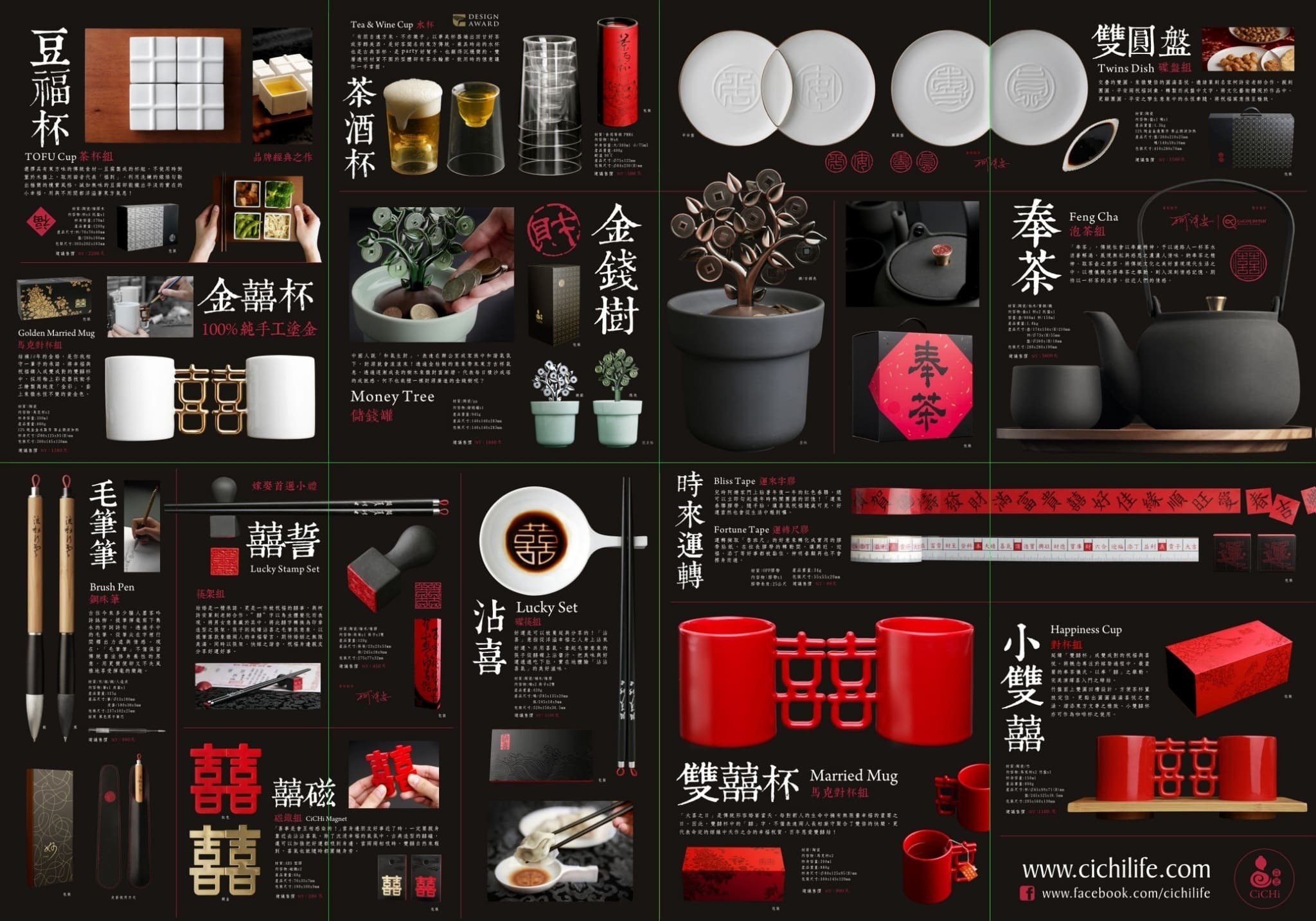
However, this path has not been so smooth. Yi Wei-shen once had to close a company due to issues with a business partner. From being in debts of 20 to 30 million NTD to now running Afterain Design, he has witnessed the ups and downs of the design industry firsthand. In 2005, Taiwan’s burgeoning cultural and creative industry brought solid growth to the design field, but three years later, the global financial crisis struck, severely impacting consumer markets. Yi says, “Designers have it tough. When the market declines, design products are the last thing people choose to buy.” Compared to his earlier “just do it first” approach, Yi began to pay closer attention to market needs. The following year, he launched the brand “CiCHi,” focusing on the gift market.
It was no longer enough for products to be just “cool” or “creative.” “CiCHi” incorporated elements of Eastern cultural customs and wordplay. For example, the “Lucky Set” dipping dish is actually a pun meaning “to dip in luck,” infusing the product with richer meaning and making it stand out strongly in the gift-giving market.
- Expanding Horizons Through International Trade Shows
Yi often travels between cities around the world to observe the latest trends in international products. Among all things, “price,” “origin,” and “design approach” are the three aspects he pays the closest attention to. Understanding how different types of design products are priced in specific regions provides valuable references for future export strategies. When he sees “Made in China” on a product, he immediately recognizes the cost considerations behind it. As for design approach, it reflects the level of creativity and craftsmanship applied. For example, on an early trip to Japan, Yi was surprised to discover that Japan was already incorporating sensor modules and mechatronic methods into creative product design, something the Taiwanese creative industry at the time could only dream of.
Traveling also helps him observe how market demands vary across cultures. Afterain Design once launched the well-known “booxi” weapon notebook brand, which targeted the U.S. market. At a trade show in Hong Kong, an American buyer purchased one of these weapon-themed notebooks. The next year, the same buyer returned and asked, “Do you have a new notebook this year?” Yi replied, “Not this year, but we do have mugs, would you be interested?” Unfortunately, the buyer specialized in selling notebooks, so naturally, there was no new order. Afterward, Yi gave this incident serious thought: “Even if you’re doing creative work, if you keep changing directions in a way that clashes with your buyers’ and the market’s logic, it won’t work. That American buyer sells notebooks, and they won’t come back next year to buy mugs, shoes, or something else.” Without hesitation, Yi decided to establish a new brand, “booxi,” solely for the notebook product line, focusing all efforts on growing it in the U.S. market.
- Going beyond Initial Buzz, Raising the Product’s “Technical” Barrier
However, cultural and creative products often face a common challenge: when they first launch, they gain attention thanks to novelty or visual appeal, but this buzz is hard to sustain. The only option then is to keep releasing new products, but that is not a long-term solution. Only by developing products with unique manufacturing techniques or materials can a brand truly secure its existing market position.
For example, in 2020, Afterain Design supported designers in launching the coffee equipment brand “JSL Craft” to break into the market from a different angle. The brand’s most famous product is its mineral sand dripper, which uses a composite mineral clay instead of paper coffee filters. The product development involved over a year of preliminary research, from determining how fine the grains needed to be to control the coffee’s flow rate, to creating a dripper that does not need perforations but still maintains steady flow. “MAKE3BOX” is another case in point. Its design process also began with material research, including tests on elasticity, toughness, durability, and storage performance. A fan website was launched along the way to gather feedback from the community, collect technical information from manufacturers, and understand consumer needs, which were continuously refined until the final product was completed.
Yi says, “Although we later realized that demand in individual markets might not be large enough, this is all part of the process of using breakthrough technologies to continuously develop products.” Today, both JSL Craft and “MAKE3BOX” enjoy stable sales, which convinces Yi that consumer habits can gradually change because of good products. This belief also fuels his courage to keep experimenting and developing new products. Currently, he has been gradually adjusting the company’s operations, focusing manpower on research and development. By managing new brands, he maintains a keen sensitivity to the market, actively involves stakeholders in research, and continues to speak through products, demonstrating design with a clear vision.
The Role of Industrial Design in Current Trends
Regarding the role of industrial design in today’s trends, Yi views design as a way to materialize trends. Taking the dimensions of “points,” “lines,” and “planes” as an example, when trends are seen as a “plane” broadly influencing various industries, design serves to concretize the “points” and “lines” within each industry. In other words, design is “the channel that materializes and actualizes imagined futures.”
Yi recalls being deeply impressed in 2000 when he saw a book by Philips titled “Design For Future.” He thought only large corporations had the capital to innovate and invest in research and development, but this also shaped his imagination and direction in design for the future. To some extent, trends influence designers’ goals, and once design works emerge, they can further transform society, revealing new trends.
Designers are magicians who realize the future, but Yi cautions that while chasing trends, one must reflect on the true core purpose of design rather than blindly fitting oneself into trending keywords. Viewing this relative world requires thinking in a higher dimension. For example, on environmental protection, Yi says, “We often say plastics are not eco-friendly, but plastics could also be eco-friendly if we looked at it from another angle.” Imagine the relative relationship between time and materials: if plastic is used to design an item that will be discarded after just two or three months, that may indeed not be an eco-friendly choice. However, if one designs an object made of plastic that can be used and maintained for ten, twenty, or even thirty years, it could be an eco-friendly possibility. Industrial designers must return to the basics, that is, solving present problems through design and realizing future ideals, which remain the unchanging goal and trend for design professionals.